
 By Ross Ballot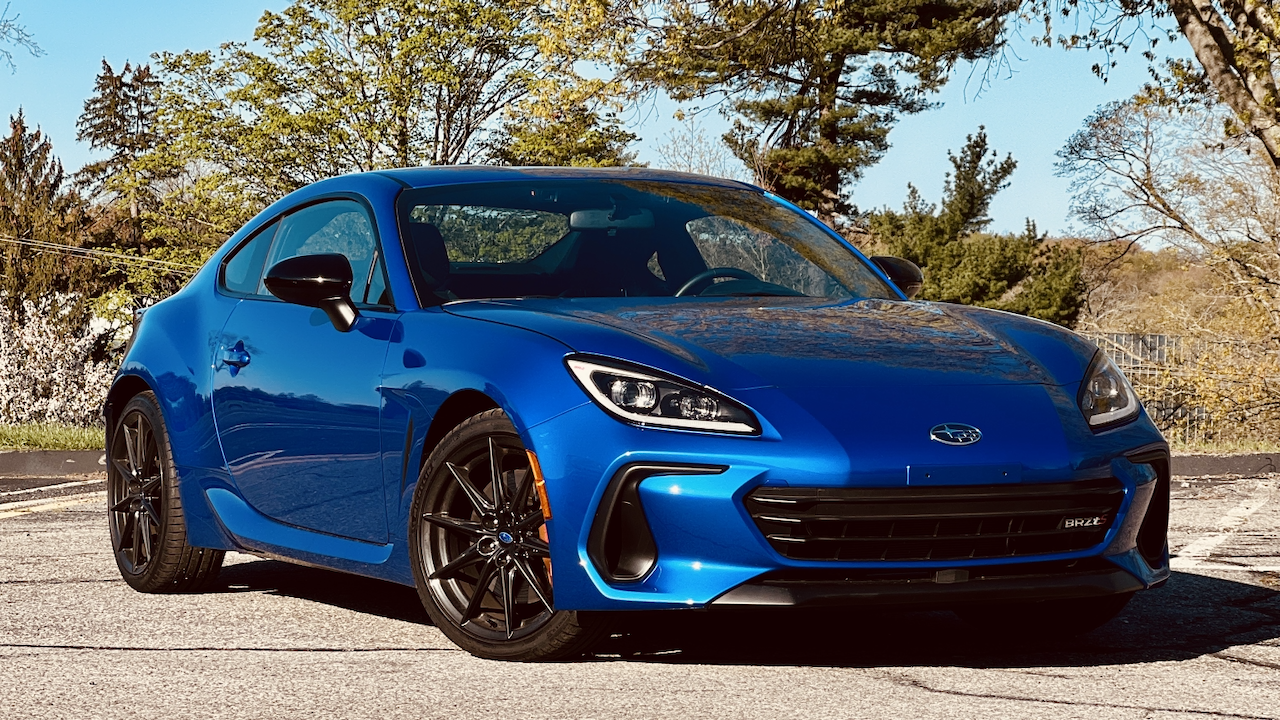
The original Subaru BRZ (and its then-branded Scion FR-S twin) was good. The current one (and its Toyota GR86 twin) is very good, if not great. As the number of affordable sports cars dwindles, the Toyota-Subaru concoction thrives. It’s a beacon of light in a land of beige, a car that invites you to actually drive, and a car that has to actually be driven to extract the most out of it.
Part of that– and much of the 86 twins’ charm– is how little extra fluff exists. This is a sports car that really leans on the roots of what driving is about.

Sure, it’s comparatively slow. Even a minivan or crossover can beat it in a drag race. The 2.4-liter Boxer engine makes 228 horsepower and 184 lb-ft of torque, and it very much is still a low number in the grander automotive landscape, but driving the BRZ is all about perspective. You feel like you’re going fast, even if you aren’t; nobody reading this needs an introduction to the concept of “slow car fast,” but it’s something that never gets old when you get out from behind the keyboard and sit in the driver’s seat.
Using the BRZ’s gearbox never gets old, either. While the Miata’s engine might be more charismatic, the Subaru’s transmission is decidedly more precise and rewarding to use. Not that this is a comparison test, but as the two most affordable driver’s cars on sale today, it’s impossible to not draw comparisons.

Let’s avoid that and focus on the BRZ. And focus on the BRZ we should, because it’s perhaps one of the best things on sale at any price. It’s so pure that it genuinely feels like a look into the past, a window into a time when sports coupes were more prevalent and CUVs/SUVs were reserved for those who didn’t have a want but rather had a need for four-wheel-drive capability or the spaciousness that generally came with the associated vehicles back then.
Even though this generation of car is only a few years old, driving the BRZ truly feels nostalgic, and its outright speed tells a similar story. Ripping off supremely rapid 0-60 MPH and ¼ mile times isn’t impressive anymore, so the BRZ’s ~5.8 and 14.5 second times (respectively) are hardly anything to write home about.

It doesn’t diminish how much fun being behind the wheel of this car is, though. Blast through the BRZ’s first two gears and you feel like a high-schooler again, slamming upshifts in a fury to extract every ounce of performance from a car that you can approachably find the limits of within the confines of a normal road.
Better yet, the delicacy of the chassis allows for you to drive the car at a certain tipping point uncommon in cars today. The steering can be manipulated to the finest point possible concurrent with being able to use the transmission and power to dance the back end around. On a back road, to quote a cliché, it’s effectively telepathic. What you tell the car to do, it does.

And that’s a joy that’s scarce among modern vehicles. You take a penalty for it– the BRZ is small, tight, cramped, inefficient relative to its footprint, and comparatively slow– but in the end, who cares? For a laugh, you can use the BRZ as an everyday, errand-capable car; yours truly packed it full of a quarterly Costco run’s worth of household needs, and it showed just how important the design brief for fitting four track wheels/tires in the car is when you actually want to use it as your only car. A car seat even fits, though work on your acrobatics and prepare to do your best impression of a contortionist to make install of said seat happen.
In the same price range, only the Miata lands higher as far as driving joy goes. But there’s no question it lacks in usability; I drove my NC Miata year-round as a DINK, but in my week with the BRZ tS I was able to throw my children in the back. Anything roughly the same size and amount of fun with the capability to do so will cost more or be drastically worse to drive.

Buyers in the market for the BRZ aren’t trying to maximize their efficiency or practicality; otherwise, they wouldn’t be in the market for a BRZ in the first place. BRZ (and GR86) buyers want fun at the forefront– with a splash of daily usability– and everything else falls behind such on the list of important traits. Amenities, as such, suffer; the infotainment is more circa 2016 than 2026, and that’s about as much as you get when it comes to tech (though Subaru EyeSight is present and nice to have from a safety perspective). The heated seats barely heat, and the seats are manually operated.
But, who cares? The seats are supportive and comfortable, the driving position is excellent, and you have a manual handbrake. Naturally-aspirated engine up front, rear-drive out back, stick shift in the middle. As far as “the perfect automotive formula” goes, this is damn-near spot-on.

The Landscape
Perhaps by now I’m beating a very, very dead horse. The BRZ, despite the Miata technically being a competitor, is really in a class of its own. Subaru’s variant starts at $35,860, with the tS we tested carrying a base price of $36,360 and as-tested price of $37,756. Over at Toyota, effectively the same vehicle starts from $31,400. The Miata starts at $30,430 and the Club trim– most comparable to the tS tested here– is $33,930 before options, many of which you want (like the Recaros and Brembo brakes), bringing the “best” Miata to around $40k. Go to the retractable hard-top RF and those numbers jump to a base of $38,450 and $41,900 for the Club (with the Recaro/Brembo package included in the latter’s price). Fun is pricey, as it turns out. One rung up the fancy ladder, BMW’s 2-Series Coupe starts at $42,200 and for the sporty M240i you have to spend $53,600.
Consider the BRZ the place in the venn diagram where the Miata Club and M240i overlap, albeit it’s more practical than the former and more dynamic than the latter, all while staying closer in price– and cost of ownership– to the Mazda. It was co-developed between Toyota and Subaru after all, and we don’t doubt the two companies want this joint venture to stand as something they can be proud of. Which they should be, considering the BRZ/FR-S/GR86 is coming up on fifteen years of production (over two generations), which is no small feat in the modern era. In a world littered with CUVs and SUVs, building and selling a sports coupe for that long should be hailed as nothing short of a miracle.

All of this is to say, the BRZ tS is a damn good time and, even with so few actual competitors, it’s fantastic when considered in a vacuum or otherwise. With a two-plus-two cabin and a front-engine, rear-wheel-drive, manual-transmission configuration, the BRZ is in a class of few regardless of price. It’s a pure, true sports car that makes you happy to drive so long as you can ignore the outside world. Camaro pulls up next to you at a stoplight? They will smoke you. But will you have a bigger smile in the BRZ if you can be blind to others’ flaunting? Hell yes.
Yay
- Chassis from the automotive gods themselves
- Excellent handling, cornering, and steering feel
- Great gearbox
Nay
- Buzzy engine that could use more character
- Excess road nose from the front end
- Gas mileage isn’t what it could be
The Takeaway
- The 2026 Subaru BRZ tS is a truly excellent sports car with fun to be had in spades and the added bonus of real-life daily usability.
(The manufacturer provided insurance and a tank of fuel for this loan, and thanks as always to the team at FMI for arranging and coordinating logistics).
 Kamil Kaluski