
 By William Byrd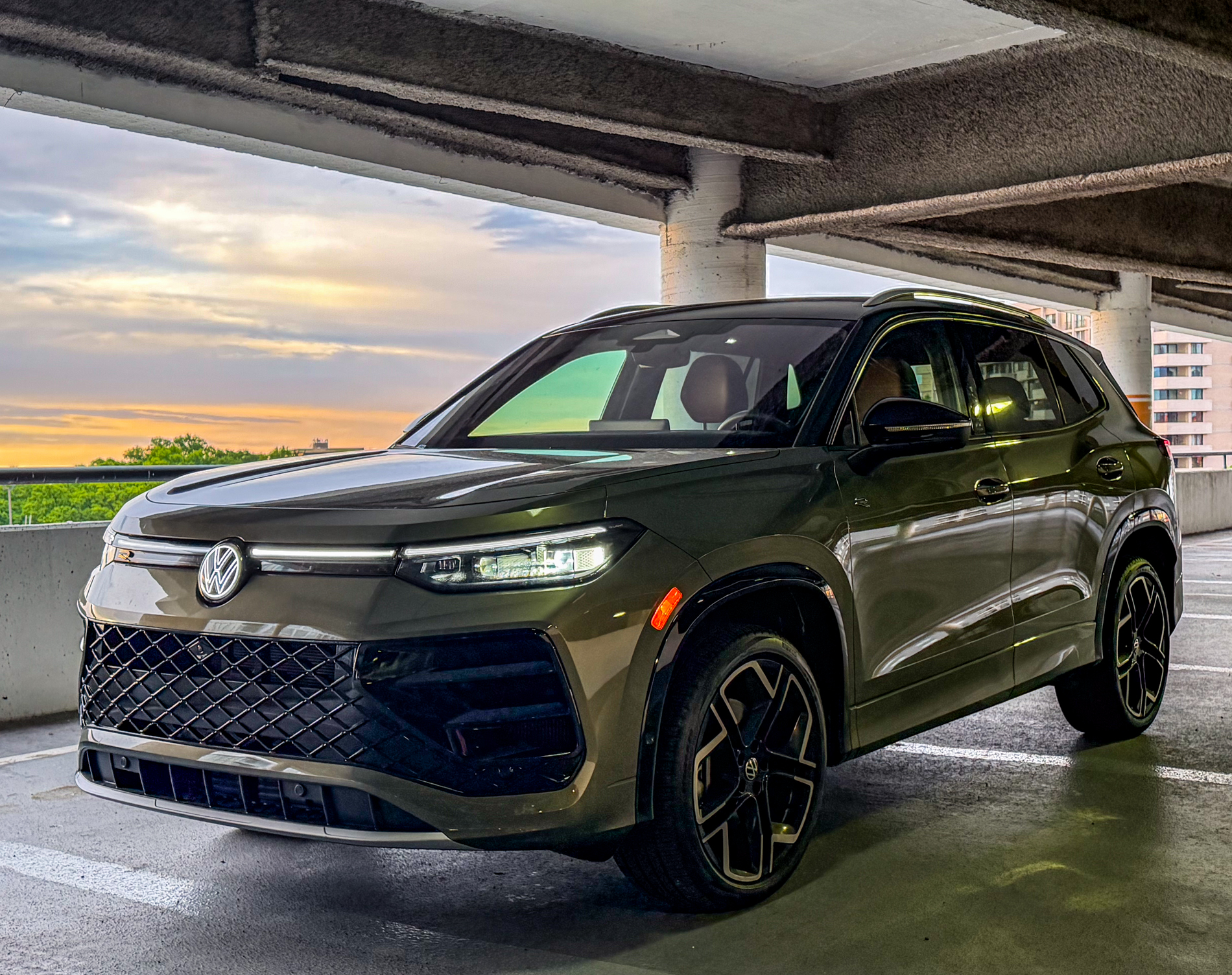
The compact SUV segment is one of the most competitive stretches of the new car market, and also one of the most forgettable. Most entries in this class are competently engineered, reasonably priced, and about as memorable as a Tuesday. The 2026 Volkswagen Tiguan SEL R-Line Turbo is not trying to be a Toyota RAV4 or a Honda CR-V. It is trying to be a Volkswagen, which means it is trying to be a little more European, a little more considered, and a little more interesting than the segment average. In Avocado Green with a Deep Black roof and Amber Brown leather inside, let’s find out whether our as-tested example at $45,410 makes a convincing case.


2026 Volkswagen Tiguan: Overview
The 2026 Tiguan lineup is a pretty straightforward situation. You get four trims, one powertrain, and a clear progression of features from the base S to the top-of-range SEL R-Line Turbo we are driving here. All versions get a 2.0-liter turbocharged four-cylinder and an 8-speed automatic transmission. AWD is optional on lower trims and standard on the SEL R-Line Turbo.

Tiguan S — $32,280.
The entry point, and it’s a genuinely strong one for the price. Heated front seats, wireless charging, an adaptive front lighting system, natural voice control complete with ChatGPT integration, and Volkswagen’s full IQ.The DRIVE suite of driver-assistance technologies is standard. Front-wheel drive comes standard, and AWD is available. At this price, the Tiguan S undercuts a lot of the competition while giving away very little in daily usability.
Tiguan SE — $37,280.
Adds a panoramic sunroof, a larger 15-inch touchscreen, a Harman Kardon premium audio system, leather seating, and ventilated front seats. AWD is available. For most buyers who want the full Tiguan experience without climbing to the top of the range, the SE is the sensible landing spot.
Tiguan SE R-Line Black — $40,030.
The style trim. Adds R-Line exterior treatment with gloss black accents, 20-inch black wheels, R-Line interior badging, and black exterior mirror housings. It’s got the same powertrain as the SE. For buyers who care about how their Tiguan looks in a parking lot, this is the one.
Tiguan SEL R-Line Turbo — $43,085 base, $45,410 as-tested.
The range-topper, and the car we’re driving here. The powertrain steps up from the 201-horsepower unit in lower trims to a 268-horsepower version of the same 2.0-liter turbo four. AWD is standard. The SEL R-Line Turbo adds massaging front seats (!), ventilated seats, a head-up display, a digital instrument cluster, power-folding mirrors, heated rear seats, a cargo area privacy cover, and R-Line exterior and interior treatment throughout.

The window sticker on our test car adds Avocado Green paint ($850), Amber Brown leather interior (no charge), and AWD (no charge at this trim). As-tested: $45,410. Let’s see what’s what.


2026 Volkswagen Tiguan SEL R-Line Turbo: Inside & Out
Avocado Green is a lovely choice. Paired with the Deep Black roof option, it comes across as deliberately styled rather than accidentally bold. The two-tone treatment works better than you might expect on paper. In a segment full of Silver, White, and Titanium Gray, Avocado Green is a excellent.
Beyond the color, the Tiguan SEL R-Line’s exterior treatment adds a front spoiler, side skirts, rear diffuser styling, and R-Line badging throughout. The 20-inch wheels fill the arches properly without being too showy. The overall stance is compact and purposeful without pretending to be something more aggressive than it is. It is a good-looking small SUV that does not get overtaken by trying to be too sporty or upscale.


The Amber Brown leather interior is a strong pairing with the Avocado Green paint. It is a warm, earthy combination that gives the cabin a personality that beige interiors don’t quite match. The R-Line trim adds stainless steel pedal caps and ambient lighting across the dashboard, and the overall effect is a cabin that is just dramatic enough to look good.
The 15-inch touchscreen is the focal point, and you also get the configurable VW Digital Cockpit Pro instrument display just ahead of the wheel. CarPlay immediately and completely takes over the main screen, and the system’s integration is clean. The Harman Kardon 12-speaker audio system is quite good. Really good. The kind of good that makes you bump the volume up a few notches just to see what it’ll do.
The massaging front seats are standard at this trim level. After a week of press cars where this feature was conspicuously absent (looking directly at you 2026 Audi RS 6 Avant Performance and ur expensive plastic blanks!), finding them standard on a $45,000 Volkswagen is amazing. VW has an excellent setup, multiple patterns, adjustable intensity, very useful on longer drives.

The wireless charging pad works reliably. Placement is sensible. Retrieval is easy. After a stretch of inconsistent wireless chargers in recent press cars, a pad that simply does its job without drama is worth noting.
The cupholders in the center stack are sized in two different formats for front-row passengers, which sounds like a small thing and is actually a small thing, but is the kind of small thing that signals someone thought about how this car gets used.


The heated rear seats are great, even though it’s summertime in the D.C. area at the moment. The cargo area privacy cover is standard at this trim. The cargo under-floor storage solution provides a useful secondary area for items you want accessible yet out of sight. The hockey bag fit just fine, but the stick ended up partially in the back seat.


2026 Volkswagen Tiguan SEL R-Line Turbo: On the Road
The 268-horsepower version of Volkswagen’s 2.0-liter TSI engine is the best upgrade at this trim, and it earns its place in the spec sheet. The power delivery is smooth and linear rather than dramatic: the Tiguan SEL R-Line Turbo does not jolt or surge, it simply accelerates with a confidence that the lower-powered trims do not quite match. Highway merging, passing, and getting up to speed from a stop all feel appropriately effortless for a compact SUV at this price. It is not a performance vehicle, but it does not drive like a dull compact SUV.
The 8-speed automatic handles the power cleanly. The Shift logic system is well-calibrated for normal driving, and in Sport mode the transmission sharpens responses without introducing harshness. The 4MOTION AWD system on our test car delivers grip in the corners and in the wet without you having to think about it.
Ride quality is composed. Not soft, not firm, just right. The Tiguan absorbs road imperfections without transmitting them to the cabin, and its NVH levels are reasonable for this class. It does not have the isolation of something twice the price, but it doesn’t feel like it is trying to achieve that either. It feels like exactly what it is: a well-engineered German compact SUV.
The head-up display is excellent: clean, well-positioned, and readable without polarized sunglasses, causing the washout issues that plague some versions. Speed, navigation prompts, and driver assist status are all visible without eyes off the road.
Parking the Tiguan is easy. The footprint is genuinely compact, the surround-view camera is high-resolution and responsive, and Park Assist handles parallel and perpendicular spots with minimal drama. After spending time in press cars that feel outsized in urban environments, the Tiguan’s manageable dimensions feel like a feature rather than a compromise.


One small detail that impressed: the volume control falls immediately to hand on the steering wheel, and the track-forward-and-back controls are in the expected position and work without looking. These are baseline expectations that a surprising number of vehicles still manage to get wrong. The Tiguan gets them right.
The automatic volume reduction when reversing, which I noted in the RS 6 review last week, is present here as well. It is becoming a recurring detail actually helps when backing a vehicle into a tight space. Or maybe I’m getting old.
Summary
The 2026 Volkswagen Tiguan SEL R-Line Turbo at $45,410 as-tested sits in interesting territory. It costs more than some mainstream compact SUV alternatives, and it does not offer three rows or hybrid powertrains to justify the premium on purely practical grounds. What it does offer is a more considered driving experience, a more distinctive design, a cabin that feels genuinely upscale for the price, and a feature list that includes massaging seats and a head-up display at a point where competitors are still talking about heated steering wheels as highlights.
In a segment where the safe play is also the forgettable one, the Tiguan SEL R-Line Turbo is the Volkswagen answer to whether a compact SUV can have a personality. It can. This one does. And at just over $45,000 with a real engine, Harman Kardon audio, massaging seats, and Avocado Green paint, it makes that personality look like a very reasonable choice. In the end, I was surprised by the Tiguan, and in this case that’s a good thing!
2026 Volkswagen Tiguan SEL R-Line Turbo
Base MSRP: $43,085 | As-Tested: $45,410 | Engine: 2.0L TSI Turbo 4-cyl | Output: 268 hp / 295 lb-ft | Transmission: 8-speed automatic | Drivetrain: 4MOTION AWD (standard) | Fuel Economy: 22/29/25 mpg (city/hwy/combined) | Cargo: 17.2 cu ft (seats up) / 47.8 cu ft (seats folded) | Assembly: Mexico
What is the big pink button in the console? Volume control in the center console? I was surprised that it wasn’t mentioned after seeing prominently in one of the first images.
The Avocado Green with the black roof is a sharp combo. I also like that the massaging seats come standard on this trim. The 15-inch screen sounds like it fits the cabin well.