
 By William Byrd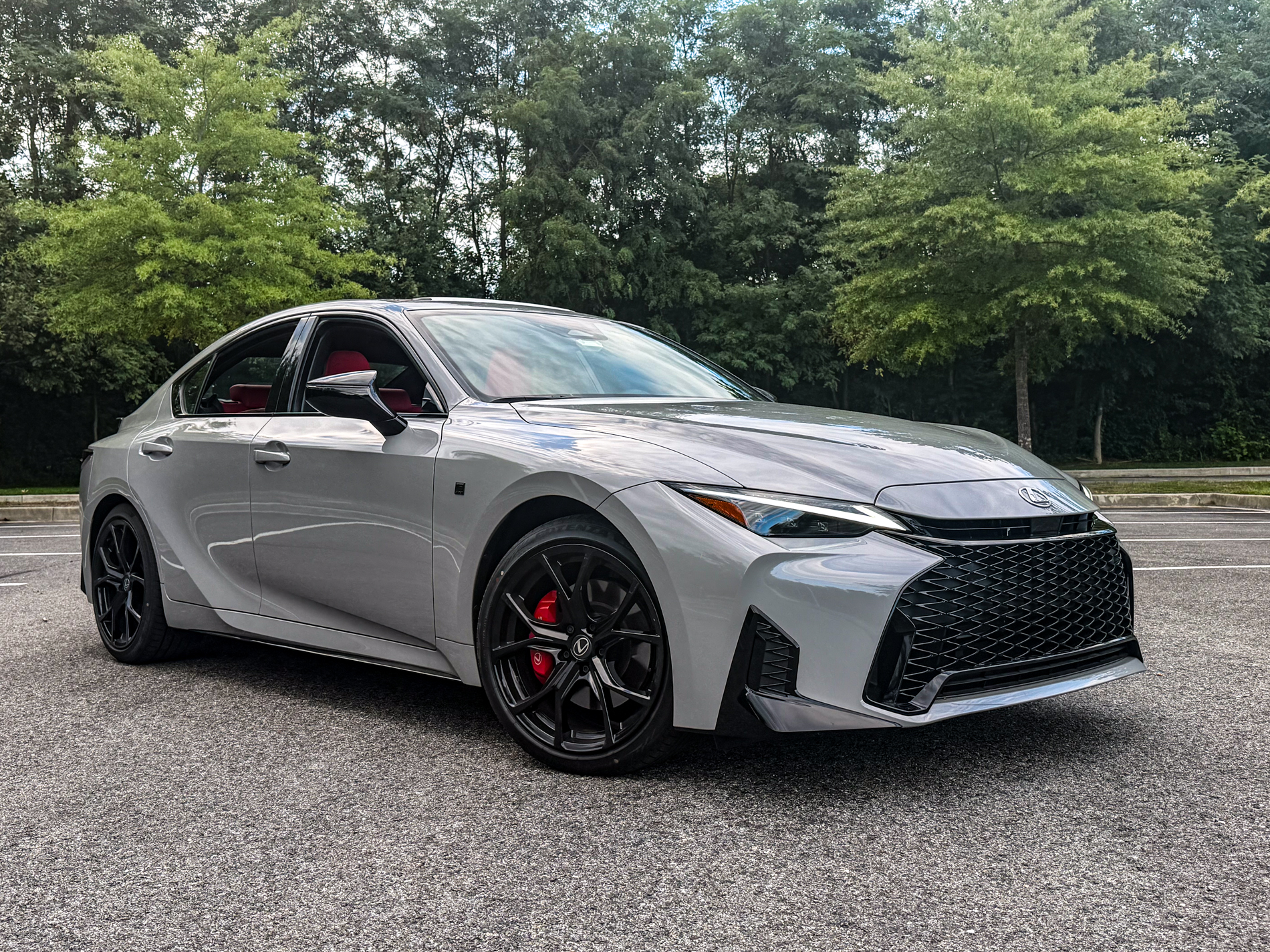
Last week I drove the 2026 Toyota GR Supra MkV Final Edition. The last Supra. This week, I am in the 2026 Lexus IS 350 F Sport, which is also, quietly, nearing the end of its run. The third generation IS has been in production since April 2013. That is thirteen years on the same platform, which, in automotive terms, is roughly equivalent to showing up to a smartphone convention with a flip phone. So consider this an exit interview. Two weeks, two cars, two Japanese sports icons in their final chapters. Let’s see how it gets on.


2026 Lexus IS 350: Overview
The 2026 IS lineup has been significantly simplified. The four-cylinder IS 300 is gone. The V8-powered IS 500 is gone. What remains is a focused, V6-only lineup in three configurations, all sharing the same 311-horsepower naturally aspirated 3.5-liter engine. In a segment where everyone else has moved to turbocharged four-cylinders chasing efficiency numbers, the IS 350 is the holdout, still doing things the old way.
IS 350 F Sport Design: $45,500.
The entry point, and honestly, the smart buy for most people. Standard equipment is substantial: NuLuxe upholstery, heated front seats, dual-zone climate control, wireless Apple CarPlay and Android Auto, the full Lexus Safety System+ 3.0 suite, and adaptive cruise control. Rear-wheel drive is standard, while AWD adds $2,000.

IS 350 F Sport — $47,950 base, $57,188 as-tested.
The car we are driving here. Steps up with heated and ventilated sport seats with driver memory, an F Sport leather-trimmed heated steering wheel, aluminum pedals, thematic ambient lighting, and access to the optional F Sport Handling Package. That package on our test car ($1,090) adds adaptive variable suspension, a Torsen limited-slip rear differential, and Sport S and Sport S+ drive modes with custom settings. Additional options on our sticker include 19-inch black BBS forged alloy wheels ($2,450), Mark Levinson Premium Audio ($1,120), triple beam LED headlights ($1,250), a panoramic moonroof ($1,100), and the Technology Package with front cross traffic alert, lane change assist, and traffic jam assist ($620). Total: $57,188.
IS 350 F Sport Special Appearance Package — limited production.
Three hundred and fifty units for North America, finished exclusively in Hakugin Matte White. Potentially a collector’s piece rather than a daily driver recommendation. If you are reading this and one is still available at your dealer, it’s probably got a pretty wild markup.

So, the better part of $60,000. Let’s see if it’s worth it.


2026 Lexus IS 350 F SPORT: Inside & Out
The IS 350 still looks good. This is genuinely surprising given that the design dates back to 2014 and has been refreshed rather than replaced. The spindle grille is…confident (much improved over the years), the proportions are right for a compact sport sedan, and in Wind paint, it looks good.
The 2026 refresh brings revised front-end styling and triple-beam LED headlights, which help the front efnd feel a bit more current even if the underlying architecture is not. The 19-inch BBS forged alloys on our test car are excellent. BBS is one of the few wheel brands where the name on the spokes actually means something.


Red interior. Not for everyone. Very much for someone. If you are that someone, you know it the moment you see it through the window, and you will order exactly this way.
However, the interior is where thirteen years on the same platform starts to show. The interior is starting to feel its age. The infotainment interface, even with the 2026 revisions, lacks the freshness of a BMW 3 Series or a Genesis G70. The screen size is respectable, the 12.3-inch display does what it needs to do, and CarPlay takes over cleanly once it connects. On the first attempt, it did not actually connect. On the second attempt, it did. Not a crisis, just a note. Didn’t have any issues after that.
And now, the things the IS does genuinely well. The sport seats on this F Sport trim are deeply bolstered, heated and ventilated, and shaped in a way that makes long drives considerably more comfortable than the Supra’s cabin I spent the previous week in. The heated steering wheel, leather-trimmed and F Sport-specific, is excellent. The HVAC controls are physical buttons styled to match the vents on either side of the dashboard. Cooling seat activation is a single button press. No menu required. My wife noticed this immediately and approved. Good marks for the IS.
There is a volume roller rather than a knob, which works fine. Immediately next to it is a large, round drive mode button. They are close enough together that reaching for the volume roller and accidentally pressing the mode button can happen. The IS is otherwise a car that rewards familiarity, and this is probably one of those rough edges that rounds off after a few weeks of ownership. The wireless charging pad works consistently and sits in a location that is genuinely easy to reach. Better than the Supra from last week by a significant margin. The phone does not slide around. It simply charges. This is all anyone asks.
Ergonomically, the shifter sits at exactly the right height and angle, perfectly aligned with the armrest, and angled slightly toward the driver’s hand. Every time I touched it, I thought the same thing: this would make a tremendous location for a manual shifter. Of course, the IS 350 is not available with a manual. This is a shame. I owned an IS 300 manual, and it was fun. Thus, I will continue to bring it up until someone at Lexus reads car reviews on Hooniverse. The windows roll up and down very quickly. This is a trivial observation. I am including it because it is the kind of thing that, in a new car, signals that details matter to the people who built it, and it is the kind of thing you notice every time you open and close it.


Going from two seats to four doors after a week in the Supra is one of those transitions that reminds you why you actually own the cars you own rather than the ones you dream about owning. Putting a bag in the back seat, rather than trying to toss it onto a passenger seat or negotiate with a 2+2 shelf, is a quiet but consistent daily pleasure. The IS has a decently sized boot, 10.8 cubic feet, which is modestly sized for the class but entirely functional.


2026 Lexus IS 350 F SPORT: On the Road
The IS 350 F Sport is not fast. Let’s establish that clearly and without embarrassment. With 311 horsepower from a naturally aspirated V6 in a car that weighs around 3,700 pounds in RWD configuration, it results in a 0-60 time somewhere around 5.6 seconds, which in 2026 puts it squarely in the territory of mildly quick rather than properly quick. The BMW 330, the Genesis G70, and the Cadillac CT4 all convey a better sense of urgency.
The upside is that it puts on a good show with its 311 horsepower. Putting it in Sport S mode makes the IS louder. Genuinely, perceptibly louder, not the theatrical speaker-augmented exhaust note that a surprising number of sport modes deploy these days. Sport S+ makes it louder still, and at that point the naturally aspirated 3.5-liter V6 sounds, it must be said, genuinely excellent. Whether it sounds better than the Supra is a close call. It might. The Supra has BMW’s B58 inline-six, which is a tremendous engine. The Lexus has a naturally aspirated V6 that has been refined for over a decade and knows exactly what it is. I suppose they are different pleasures.
Sport S+ mode also activates a horizontal tachometer bar across the top of the driver display. It is a small thing, a purely cosmetic feature that communicates nothing that the main display does not already show. It reminded me immediately of the Honda S2000’s high-revving display. It is completely unnecessary, and I liked it every single time it appeared.
The Handling Package’s adaptive variable suspension is the other reason to opt for the F Sport trim. Normal mode is compliant and comfortable, notably better over speed bumps than the Supra was. Sport S mode firms things up in a way that feels taut rather than punishing. Sport S+ is not quite track-oriented, but it is noticeable on public roads. The Torsen rear differential helps plant the power cleanly out of corners, and the rear-wheel drive balance is fundamentally more entertaining than the AWD version’s safer composure.
On the safety front, I had no false alarms from the driver-assistance systems to report this week, which is a relief after the Supra’s memorable highway incident. The IS 350’s Lexus Safety System+ 3.0 operated quietly and correctly throughout the test. This is the baseline expectation, and it is worth mentioning when it is actually met.
Summary
The 2026 Lexus IS 350 F Sport, as tested at $57,188, is a thirteen-year-old platform wearing its age honestly. It is slower than its competitors. Its interior is less current. Its infotainment is not best-in-class. It also sounds spectacular in Sport S+. It rides comfortably in Normal. It has physical HVAC buttons, a wireless charger that actually works, a shifter positioned as though it were waiting for a manual transmission, and a solid naturally aspirated V6.
At the end of the week, I found myself thinking about something. Maybe I do not actually need a massive amount of power to be happy. That is a strange thought for someone who has owned forty-four cars. But perhaps what I actually need is something that sounds good, looks good, goes pretty well, and is relatively comfortable to live with. Something with four doors and somewhere to put a bag, perhaps a child. Maybe that is why they sell so many Chargers, Challengers, and Durangos. They never had the best handling, the best interior, or the freshest platform either. They just have character, and character turns out to go a long way.
The IS 350 has character. When the exit interview is this enjoyable, you start to regret that the position is being eliminated.
2026 Lexus IS 350 F Sport
Base MSRP: $47,950 | As-Tested: $57,188 | Engine: 3.5L Naturally Aspirated V6 | Output: 311 hp / 280 lb-ft | Transmission: 8-speed automatic | Drivetrain: RWD | 0-60: ~5.6 sec | Fuel Economy: 19/27/22 mpg (city/hwy/combined) | Cargo: 10.8 cu ft | Assembly: Tahara, Aichi, Japan