
 By Jeff Glucker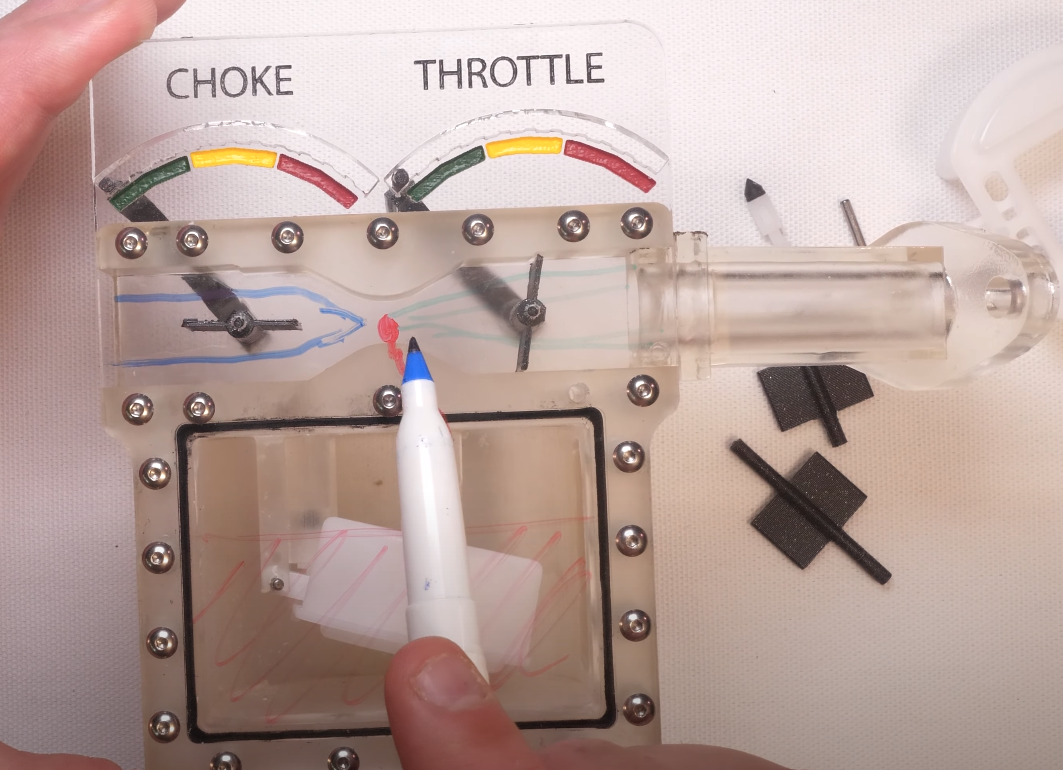
You know how an engine makes the wheels do the spinning, yes? It’s all part of the four-stroke combustion process. That is intake, compression, combustion, and exhaust. You probably also know how a carburetor works too. But do you really know what’s going on in there? I’m sure you have a good idea. But today you’re going to know exactly what’s happening because Smarter Every Day has a great video showing precisely how this air-fuel adventure occurs.
For some a carb seems like the stuff of mechanical wizardry. But it’s really simple stuff. And this is the best video showing that which I’ve come across. Now I need to get another car with carburetors again…
 Ross Ballot
Cool illustration.
If you fancy an adventure with a certain Mr. Rochester, I’ll make you a heck of a deal on a Trans Am.
I know a guy with a Rochester carb on his hot rod* that was from a Buick and had a linkage for a long forgotten convenience system where the starter button for the engine was under the gas pedal; to start the car you just put the pedal to the metal and zoom! The linkage was to make sure the throttle didn’t actually open all the way. I wonder what happened if it failed and the car was in gear?
*Buick carb on an Olds engine through a LaSalle tranny to a Pontiac diff, all riding in a ’41 Ford chassis.
Funny, when I think about a carburetor, I think about a car engine, not a small engine. So it was funny to me that he immediately went to a tiller and questioned running a carb on multiple cylinders. It makes sense in today’s context.
That was pretty well done and enjoyable. I didn’t realize how simple the basic idea of a carburetor was and, frankly, I was surprised that engine ran on that thing.
I don’t know much about them, but I think the carb in some of the very early cars basically involved dripping fuel into the airflow and letting it vaporise off the metal base.
Or, as this carburetor for a model engine shows, the air would just get sucked into the bowl, splash the fuel and vaporize, then get sucked into the engine.
https://ibb.co/bLQByty
Wow, wouldn’t that be prone to suck in too much fuel at certain angles or when being shaken too much on a rough track?
I imagine it would. Probably why carbs went with the float and needle style instead. But this is at least suitable for a stationary engine.
Great content! Keep up the good work!
That is one of my favourite channels, this guy is beyond competent as a teacher, and always so positive. Learned something here! The next step would be to understand what and how one adjusts a carb. This has always baffled me. I once drove my ’71 Volvo 145 to Germany with carb settings meant for a 164, a totally different engine from the I4 redblock. My mechanic blundered, and I had no clue how to adjust it, so in 30C weather, I had to drive with the heater fully open to avoid boiling my engine.